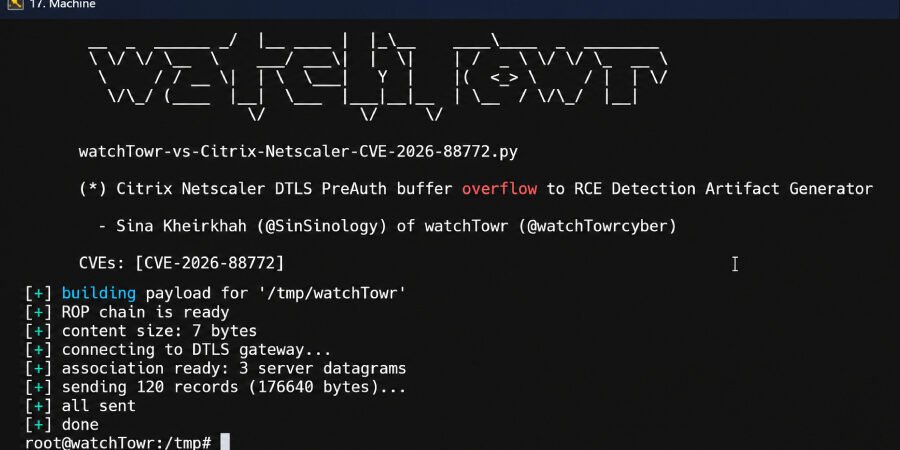
Critical Citrix NetScaler CVE-2026-88772 Vulnerability Exposes Users to Shellcode Execution Risks
Overview of CVE-2026-88772
A recently disclosed security vulnerability in Citrix NetScaler ADC and Gateway, tracked as CVE-2026-88772, has raised significant alarm among cybersecurity professionals. This critical flaw, which received a high Common Vulnerability Scoring System (CVSS) score of 9.5, is categorized as a memory overflow bug specifically linked to the Datagram Transport Layer Security (DTLS) protocol used in the NetScaler architecture.
Technical Details of the Vulnerability
The core issue stems from improper memory handling during the parsing of DTLS packets. Attackers exploiting this vulnerability can execute arbitrary code remotely without authentication, allowing them to gain unauthorized access to sensitive systems.
- Location: NetScaler ADC and Gateway systems.
- Exploit Type: Pre-Authentication, enabling attackers to bypass login credentials.
- Attack Vector: Remote code execution through malformed DTLS packets.
Implications of the Exploit
Given the nature of this vulnerability, the implications are severe. Organizations utilizing Citrix NetScaler products are at heightened risk if they have not yet applied the necessary patches or upgrades. The ability for attackers to gain control remotely means that sensitive data, network integrity, and overall system security could be compromised.
Active Exploitation in the Wild
Since its disclosure, researchers have observed active exploitation of CVE-2026-88772, indicating that threat actors are already taking advantage of unpatched systems. This urgency underscores the necessity for immediate action on the part of system administrators to mitigate risks.
Recommendations for Immediate Action
To protect against potential exploits stemming from CVE-2026-88772, cybersecurity experts recommend that affected organizations take the following steps:
- Patch Systems: Immediately apply security patches released by Citrix to address the vulnerability.
- Review Security Protocols: Evaluate existing security measures to ensure they are robust enough to prevent exploitation.
- Monitor Systems: Implement continuous monitoring for unusual activity that may indicate an attack.
- Educate Staff: Conduct training sessions for IT staff about the implications of this and similar vulnerabilities.
Conclusion
The discovery of CVE-2026-88772 highlights the ever-evolving landscape of cybersecurity threats impacting widely used technologies. Organizations must prioritize timely updates and maintain vigilant security practices to protect themselves against active exploitation and potential data breaches.
Source: thehackernews.com