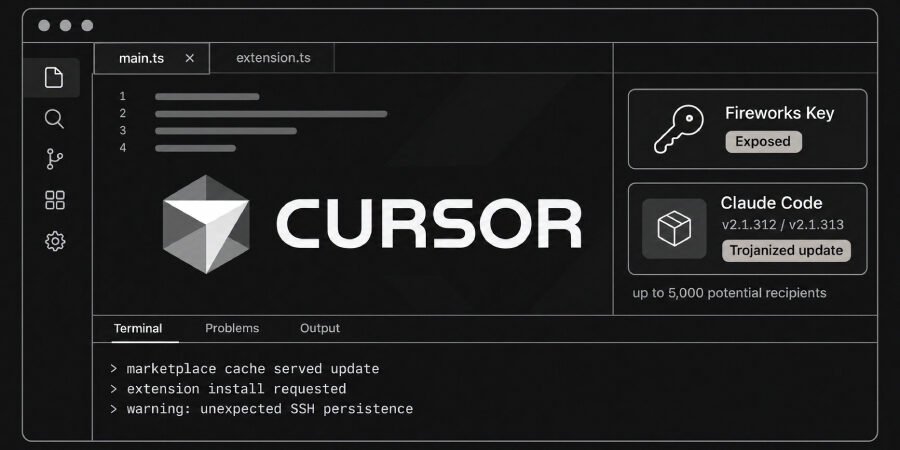
Stolen Fireworks AI Key Triggers Trojanized Claude Code Extension Incident on Cursor
Background and Context
The recent breach involving Cursor’s Claude Code extension serves as a stark reminder of the fragility of the current cybersecurity landscape. The incident, which unfolded due to the theft of an access key associated with Fireworks AI, underscores how interconnected modern software ecosystems are. In an age where software dependencies proliferate, exposing a single access key can lead to cascading vulnerabilities that affect not just one organization but an entire network of users and services. The rise of AI-driven tools has accelerated the adoption of new technologies, but it has also opened doors to sophisticated attacks that exploit these dependencies.
Historically, the tech industry has witnessed similar incidents, such as the SolarWinds hack in 2020, where attackers compromised a widely used IT management software to infiltrate numerous government and private networks. Much like the SolarWinds case, the Cursor incident illustrates how a breach can start from a seemingly innocuous point of failure—an exposed access key—yet lead to significant ramifications across the ecosystem. As organizations increasingly rely on third-party tools and extensions, the need for robust security protocols becomes ever more critical.
Moreover, this incident comes at a time when regulatory scrutiny surrounding data protection and cybersecurity is intensifying globally. The European Union’s General Data Protection Regulation (GDPR) and the forthcoming U.S. National Cybersecurity Strategy are setting higher standards for data handling and breach notification. Organizations that fail to secure their systems may face not only reputational damage but also substantial financial penalties. Thus, the Cursor incident not only highlights technical vulnerabilities but also raises questions about compliance and accountability in the software supply chain.
Technical Analysis
At its core, the breach of Cursor’s Claude Code extension was facilitated by the exposure of a critical access key issued to Fireworks AI. This key, intended for legitimate use, became a vulnerability when it was inadvertently leaked, allowing attackers to leverage it for unauthorized access. The attackers used the compromised key to interact with Cursor’s extension marketplace, effectively bypassing typical authentication mechanisms that would ordinarily protect such resources. This highlights a significant flaw in the access control measures implemented by both Fireworks AI and Cursor.
Once inside the system, the attackers executed a strategy known as **Trojanization**. This involves embedding malicious code within legitimate software, thereby masquerading as a trustworthy application while performing harmful actions in the background. In this case, users who downloaded the compromised Claude Code extension unknowingly installed a Trojan that could potentially exfiltrate sensitive data or compromise their systems further. The use of **malicious code** in trusted applications is a growing concern in cybersecurity, as it blurs the lines between secure and vulnerable software.
The implications of this breach extend beyond immediate technical vulnerabilities. The use of AI in software development has made it easier to write and deploy code quickly, but it has also made it easier for malicious actors to introduce harmful elements. With AI models increasingly integrated into the software development lifecycle, ensuring their security becomes paramount. The reliance on AI opens new vectors for exploitation, making traditional security measures less effective unless they evolve to meet these new challenges.
Scope and Real-World Impact
The fallout from the Cursor incident is significant, affecting both individual users and organizations that utilize the Claude Code extension. Cursor’s marketplace serves numerous developers and companies that rely on AI-driven tools for various applications. The compromised extension could potentially expose user data, proprietary algorithms, and other sensitive information. The scale of the impact is reminiscent of the NotPetya attack in 2017, which wreaked havoc across multiple sectors by exploiting software supply chain vulnerabilities.
As organizations increasingly adopt AI technologies, the consequences of such breaches are magnified. The potential for data theft, intellectual property loss, and operational disruption can lead to long-term damage for affected entities. Moreover, the breach raises concerns not only about the immediate technical implications but also about the trustworthiness of software ecosystems. Users may become hesitant to adopt new technologies, fearing similar incidents could compromise their data integrity.
Attack Vectors and Methodology
- Identification of the exposed access key linked to Fireworks AI.
- Unauthorized access to Cursor’s extension marketplace using the compromised key.
- Embedding malicious code within the legitimate Claude Code extension.
- Distribution of the Trojanized extension to unsuspecting users.
- Execution of malicious activities once users installed the compromised extension.
Mitigation and Defense Recommendations
- Implement strict access control measures and regularly audit access keys.
- Utilize multi-factor authentication (MFA) to enhance security for sensitive systems.
- Conduct regular security assessments and code reviews of third-party integrations.
- Develop a robust incident response plan to quickly address any breaches.
- Educate users about the risks of downloading software from external sources and encourage vigilance.
Industry Implications and Expert Perspective
The Cursor incident is a wake-up call for the tech industry, emphasizing the critical need for enhanced security practices in software development and deployment. As more organizations integrate AI solutions, the potential attack surface continues to expand, necessitating a reevaluation of current cybersecurity frameworks. Experts suggest that the industry must prioritize security by design, incorporating rigorous testing and validation processes for third-party applications before deployment.
Furthermore, the incident reflects a broader trend of increasing sophistication in cyberattacks, where attackers leverage minor vulnerabilities to gain footholds in larger systems. Moving forward, organizations must adopt a proactive approach to cybersecurity, ensuring that all software dependencies are regularly monitored and assessed for vulnerabilities. The ramifications of this incident will likely influence how organizations approach their cybersecurity strategies for years to come.
Conclusion
The breach of Cursor’s Claude Code extension, triggered by the theft of an access key from Fireworks AI, highlights the profound vulnerabilities present in our increasingly interconnected software ecosystems. As organizations rush to adopt AI-driven tools, the potential for malicious exploitation grows, necessitating a reevaluation of existing security practices. The lessons learned from this incident should serve as a catalyst for improving security measures across the board, ensuring that trust in software ecosystems is not easily eroded by the actions of malicious actors.
Original source: thehackernews.com