Exploring GPUThor: A New Rowhammer Attack Threatening NVIDIA RTX A6000 Security
Introduction to GPUThor
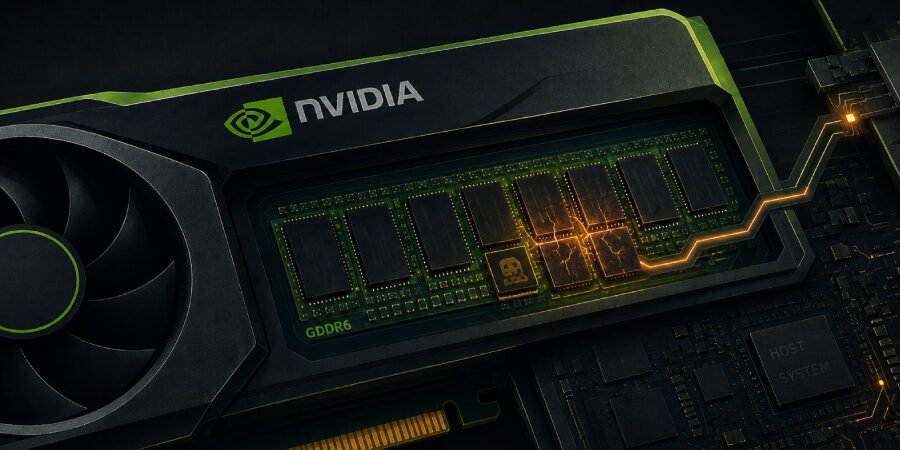
Recent research from the University of Toronto has unveiled a significant security vulnerability known as GPUThor, which exploits the Rowhammer attack vector against NVIDIA workstation GPUs, specifically targeting models equipped with GDDR6 memory. This method circumvents the system’s built-in Error Correction Codes (ECC), a protective measure that NVIDIA recommends for mitigating such threats.
The Mechanics of Rowhammer
Rowhammer is a hardware vulnerability that enables an attacker to manipulate DRAM memory cells by repeatedly accessing (or “hammering”) rows of memory. This repeated access can lead to bit flips in adjacent rows, compromising data integrity. The GPUThor attack amplifies the potential of this vulnerability by leveraging the memory architecture of NVIDIA’s RTX A6000 GPUs, which are widely used in professional environments for tasks requiring high computational power.
Implications of the GPUThor Attack
The discovery of GPUThor has far-reaching implications for both security analysts and organizations relying on GPU-based computing. The attack allows for:
- Denial-of-Service (DoS): By exploiting GPU memory, an attacker can incapacitate critical services, leading to potential downtime in high-stakes environments.
- Privilege Escalation: Attackers can gain root shell access, granting them elevated permissions which can be exploited to execute unauthorized actions within a system.
As GPUs become increasingly central to workloads in artificial intelligence, scientific computing, and creative tasks, the consequences of such vulnerabilities can be particularly severe.
Expert Opinions on Mitigation Strategies
Security experts are urging immediate attention to address the GPUThor vulnerability. Recommendations include:
- Enhanced Monitoring: Implementing rigorous monitoring of memory access patterns to detect unusual activities that might signal a Rowhammer attack.
- Firmware and Software Updates: Regularly updating GPU drivers and firmware to incorporate the latest security patches from manufacturers, particularly from NVIDIA.
- Hardware Upgrades: Considering the transition to newer memory technologies that offer greater resilience against Rowhammer attacks.
It is essential for organizations to be proactive in their approach to cybersecurity, particularly as such hardware vulnerabilities continue to evolve.
Research Behind GPUThor
The GPUThor attack illustrates the ongoing arms race between hardware manufacturers and cybersecurity researchers. The University of Toronto’s research team employed sophisticated techniques to manipulate DRAM across four different architectures, confirming that even advanced error correction implementations could be bypassed. This highlights the need for improved hardware designs that can withstand such novel attack vectors.
Conclusion
The emergence of the GPUThor Rowhammer attack marks a critical moment in the landscape of GPU security. As organizations increasingly depend on GPU technology, understanding and mitigating these vulnerabilities becomes paramount. With the academic community continuously exploring hardware weaknesses, it is imperative for manufacturers and users alike to remain vigilant and proactive in enhancing their security measures.
Source: thehackernews.com