Critical GeoServer Vulnerabilities Under Attack: Understanding RCE Chains and Their Implications
Overview of the Vulnerabilities
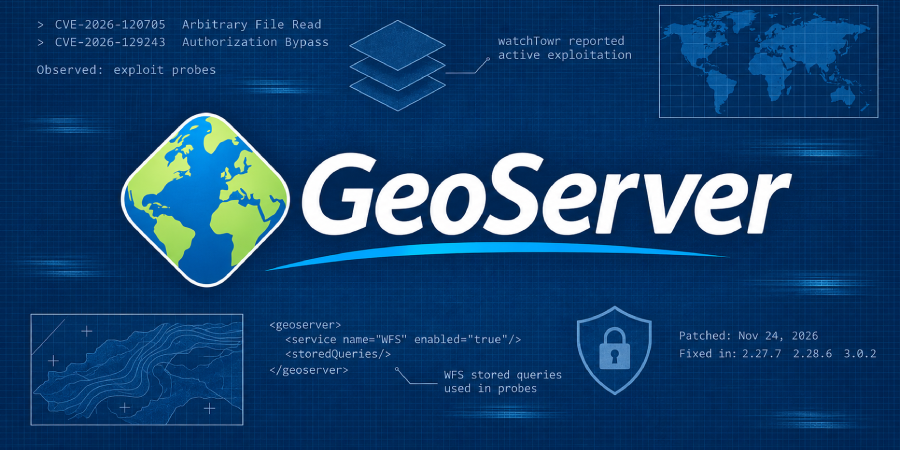
Recently, cybersecurity researchers at watchTowr reported that hackers are actively leveraging two critical security flaws in GeoServer, specifically CVE-2026-120705 and CVE-2026-129243. These vulnerabilities pose significant risks to organizations using this open-source server for serving geospatial data, which can lead to severe security breaches and data exposure.
Details of the Security Flaws
The identified vulnerabilities include:
- CVE-2026-120705 (CVSS score: 8.6) – This flaw allows for arbitrary file reading, meaning that attackers can access local text files that the GeoServer process can read. This could potentially lead to the exposure of sensitive configuration files and other crucial data stored on the server.
- CVE-2026-129243 – While specific details regarding this vulnerability were not extensively disclosed in the reports, it is associated with a remote code execution (RCE) chain that could be exploited in conjunction with the first vulnerability to escalate attacks further.
Implications of the Exploits
The exploitation of these vulnerabilities has significant implications for organizations relying on GeoServer for their geospatial data services. The ability for an attacker to read arbitrary files could lead to:
- Exposure of sensitive credentials stored in configuration files.
- Increased risk for data breaches, as attackers could further access other interconnected systems.
- Potential for lateral movement within a network, making it easier for attackers to escalate their privileges and deploy additional payloads.
Expert Analysis on Attack Vectors
Security experts emphasize that the combination of file read vulnerabilities with remote code execution capabilities creates a dangerous attack vector. By obtaining sensitive files, attackers can gather insights into the information architecture of a target organization, allowing them to craft more effective attacks.
According to cyber threat analyst Dr. Emily Carter, “These vulnerabilities highlight a growing trend where vulnerabilities are being chained together to circumvent traditional security measures. Organizations need to prioritize patching and implementing defense-in-depth strategies to guard against multifaceted attacks.”
Mitigation Strategies
Organizations using GeoServer should take swift action to mitigate risks associated with these vulnerabilities:
- Update GeoServer to the latest version where these vulnerabilities have been patched.
- Conduct a thorough audit of system configurations to ensure that sensitive files are not accessible to unauthorized users.
- Implement network segmentation to minimize the risk of lateral movement in case of a breach.
- Regularly review and update security protocols to align with emerging threats.
Conclusion
The exploitation of the critical GeoServer vulnerabilities CVE-2026-120705 and CVE-2026-129243 underscores the importance of proactive security measures in the face of evolving cyber threats. As organizations modernize their geospatial services, they must remain vigilant and responsive to emerging vulnerabilities to safeguard their data integrity and operational security.
Source: thehackernews.com